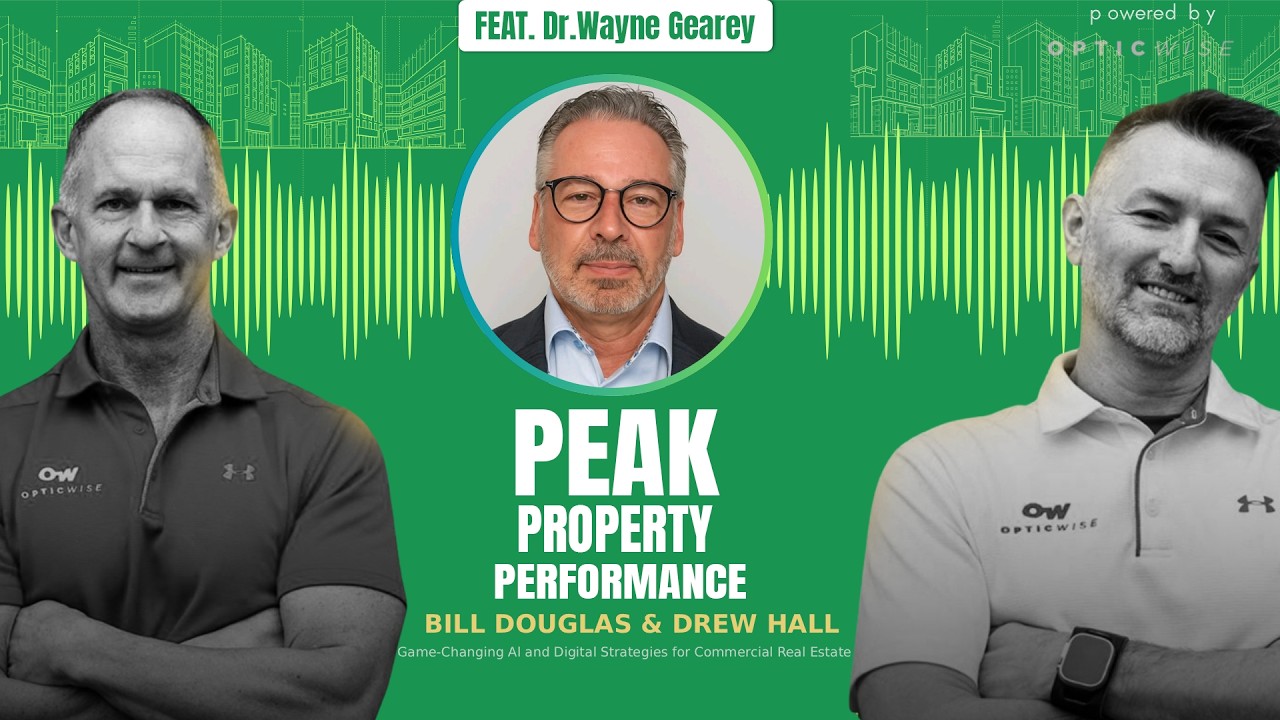
In the rapidly evolving landscape of commercial real estate, the difference between success and stagnation often hinges on the speed and accuracy of decision-making. As our industry grapples with a deluge of data, the challenge is no longer just about access but about transforming this static data into actionable insights. In the latest episode of the Peak Property Performance Podcast, we explore the shift from static data to decision velocity, featuring insights from Dr. Wayne Geary, whose experience spans industry giants like CoStar and Newmark. If you don't own your data & digital infrastructure, your vendors do. Join us as we delve into the nuances of leveraging AI and location intelligence to redefine real estate success.
Leveraging Geo AI for Rapid Decision Making
The conversation kicks off with a profound insight from Dr. Wayne Geary on the transformative power of Geo AI. Traditionally, geographical information systems have been used extensively for mapping and location analytics. However, the introduction of AI into this space is reshaping how we perceive and utilize these tools. Dr. Geary explains how real-time data, combined with AI, can now detect construction activities in specific markets, offering an unprecedented level of accuracy and timeliness.
AI bots can be trained to observe changes over time, offering insights that once took days to gather, now achieved in mere seconds.
This capability isn't just about accelerating processes; it's about enhancing the quality of decisions. For instance, by accessing up-to-the-minute satellite imagery, operators can proactively respond to market changes, ensuring that their strategies are always aligned with the latest developments. This shift from retrospective analysis to current data access is a game-changer for commercial real estate.
Listen to the full episode to hear more about how AI is changing the status quo in CRE.
The Role of Speed in Real Estate Decisions
One of the most compelling aspects of AI-driven insights is the speed with which data can now be processed and applied. Dr. Geary shared a fascinating case study involving a manufacturing client in the trading card business. By leveraging historical weather data and AI, they could accurately assess storm risks for potential facility locations.
Using GOAI, we calculated a one in 200 million chance that two facilities would be simultaneously impacted by adverse weather conditions.
This kind of precision not only influences site selection but also has the potential to impact insurance premiums and operational risk assessments. The ability to project environmental risks with such accuracy empowers CRE owners to make informed decisions that balance opportunity with risk management. As Bill Douglas aptly puts it, "The speed you're talking about is not just the speed to process, it's the speed to current." The immediacy of these insights is what allows operators to pivot strategies on the fly, maintaining a competitive edge.
Data Ownership and Ethical AI Use
With great power comes great responsibility, and the integration of AI into real estate operations is no exception. Dr. Geary highlights the importance of data ownership and the ethical use of AI in decision-making. The conversation sheds light on the pitfalls of relying solely on AI without human oversight, echoing the sentiment that while AI can automate processes, it cannot replace the nuanced understanding that human expertise brings.
The concept of Centaur, where human intelligence and machine efficiency combine, is crucial in this context. As Dr. Geary notes, "The best model is that expert-based system using the machine to automate those things for time to get to a quicker decision." This synergy ensures that AI-produced data is not only accurate but also applicable to real-world scenarios, preventing costly missteps that could arise from misinterpreted data.
Furthermore, the conversation touches upon the challenges of data silos within organizations. Dr. Geary advocates for the creation of comprehensive data lakes that serve as centralized repositories for all asset-related data. Such an approach not only streamlines data access but also enhances the effectiveness of AI applications, ensuring consistency and reliability across different use cases.
For more insights on how data ownership and ethical AI use are transforming the commercial real estate landscape, listen to the full episode.
Breaking Down Data Silos with AI
In today's complex real estate environment, data silos can severely limit operational decision-making. Many commercial real estate companies manage a plethora of systems (from property management to building automation) all operating as isolated islands of data. Dr. Geary highlights that the ideal solution lies in the creation of a unified data lake. This comprehensive repository not only streamlines data access but also enhances the effectiveness of AI applications.
Drew Hall, our Co-Founder & Chief Architect, emphasizes the need for a consistent and singular source of truth. "When we have a data lake that serves all assets, we can run advanced models, like drive time to work, across different asset types, be it office or manufacturing. This consistency allows for more accurate and reliable decision-making," Drew explains.
One example of successful data integration at work involved the creation of a site selection model. By utilizing a unified data lake, the model could predict attrition rates and HR policy impacts, providing clients with actionable insights. The result? More informed business choices, faster responses to market demands, and ultimately, enhanced property performance.
Human Expertise in AI-Driven Real Estate
While AI offers exceptional capabilities in processing and analyzing data, Dr. Geary is quick to remind us that human expertise remains irreplaceable. AI can generate insights, but the human touch is essential for interpreting these insights within the context of real-world applications. The concept of the "Centaur" model, as Dr. Geary refers to it, combines human intuition with machine efficiency, ensuring that the decisions made are both quick and contextually accurate.
"An expert-based system using AI automates tasks for quicker decisions, but the broker's expertise remains invaluable. You can't model years of asking the right questions and building relationships," Dr. Geary notes.
For real estate operators, this means training staff to use AI as a tool, not a crutch. AI should be seen as a thought partner, not the thought leader. By leveraging both AI insights and human expertise, CRE owners can achieve a balanced approach that maximizes efficiency while minimizing risk.
AI's Limitations and Real-World Applications
Despite its potential, AI is not without limitations. Dr. Geary shares candid insights into situations where AI-generated outputs seemed correct but were ultimately unusable due to a lack of real-world applicability. "We can program machines to reply quickly, but we can't program them to think like humans. AI serves as a valuable tool, but it can't replicate human consciousness," he asserts.
This limitation is why OpticWise stresses the importance of validating AI outputs. CRE operators must critically assess AI-generated insights, ensuring they align with practical and operational realities. It's not just about the data; it's about the context in which that data is applied.
AI's role in real estate is evolving, and its integration with human expertise is crucial. As Dr. Geary and Drew Hall agree, the future of AI in real estate lies in its ability to augment human capabilities, not replace them.
Actionable Takeaways for CRE Owners
The insights shared in this episode of the Peak Property Performance® Podcast underscore the transformative potential of AI in commercial real estate. However, the successful integration of AI requires a balanced approach that combines technical innovation with human expertise.
First, consider developing a unified data strategy. A centralized data lake can eliminate silos, providing a consistent and reliable source of information across all assets. This approach not only enhances operational efficiency but also maximizes the potential of AI applications.
Second, invest in training your team to harness AI effectively. Encourage your staff to view AI as a tool that supports, rather than replaces, their expertise. This mindset will ensure that AI serves as a valuable partner in the decision-making process.
Finally, prioritize ethical AI use and data ownership. As we often say, "If you don't own your data & digital infrastructure, your vendors do." By maintaining control over your data, you empower your organization to make informed decisions that align with your strategic objectives.
For more insights and practical advice, consider exploring our Peak Property Performance® book. It's a comprehensive guide to navigating the complexities of data and digital infrastructure in commercial real estate.
About OpticWise: OpticWise provides owner-controlled data & digital infrastructure for commercial real estate, from PPP Audits to portfolio-wide intelligence. See how we operate or read customer outcomes.
Peak Property Performance® Podcast
Have a story to share?
We're always looking for CRE leaders with real-world experience in data, digital infrastructure, and building operations.
Request to Be on the Show