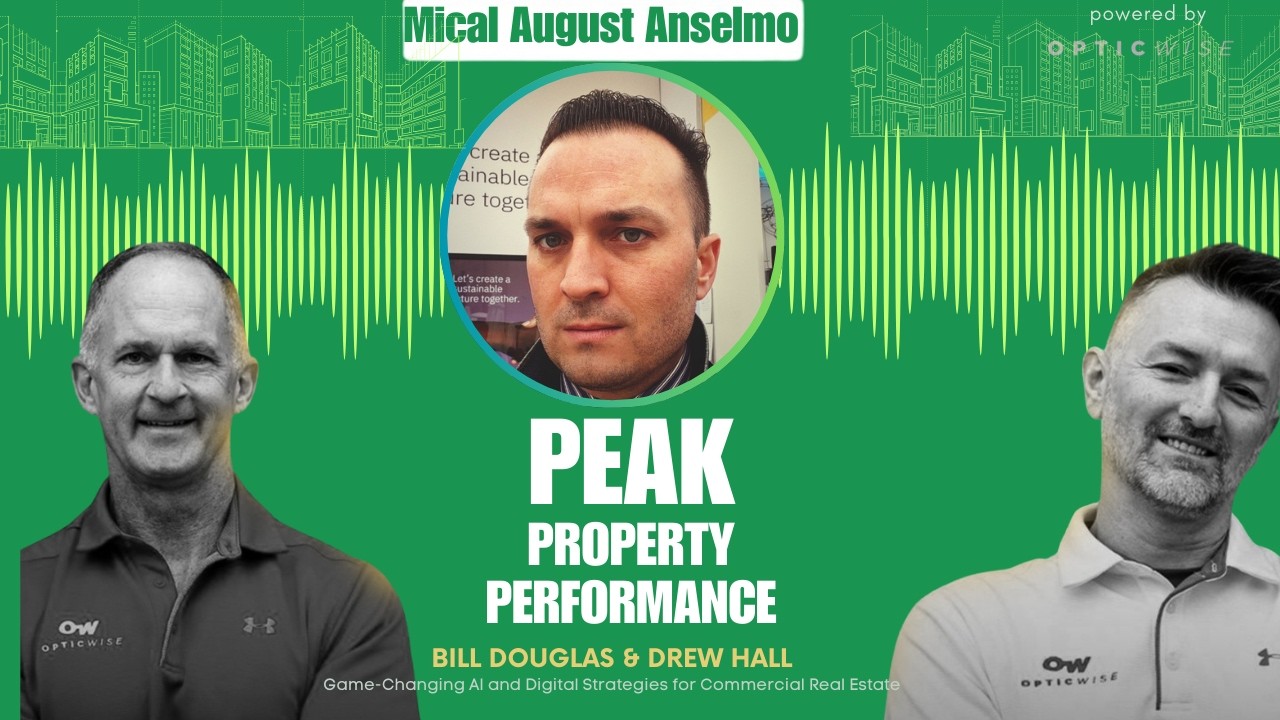
In the fast-evolving world of commercial real estate, energy data and artificial intelligence have emerged as the new performance engines driving property success. However, without owning your data and digital infrastructure, you risk letting vendors dictate your operational capabilities and competitive edge. This episode of Peak Property Performance® digs into how AI and energy data are revolutionizing commercial real estate, featuring insights from our guest, Mical August Anselmo, a leader at the intersection of technology and sustainability. Join us to understand how organizations leverage these tools to enhance efficiency, maximize ROI, and stay ahead in a competitive market. Listen to the full episode.
Bridging the Gap: From Utility Bills to Actionable Intelligence
Most commercial real estate owners believe they have a handle on their energy data, yet there's often a significant gap between having data and having actionable insights. As Mical August Anselmo points out, many still struggle with basic access to utility bills, an essential foundation that should be easily accessible but is frequently buried within finance departments or scattered across multiple systems.
Anselmo highlights a common scenario: "There's folks that still don't have access to utility bills. They're having a really hard time just getting the utility bill data, not from just a single building, but their entire portfolio." The first step is upgrading data management processes to ensure that utility data is accurate and up-to-date, thereby laying the groundwork for more advanced analytics and data integration.
Furthermore, disparate systems and contractors exacerbate this issue. Different vendors handle various systems (like lighting controls or BMS systems) leading to fragmented data streams. Bringing these data points together into a central repository is critical for owners aiming to improve efficiency and reduce costs. It's about lifting the veil on operations and making informed decisions based on complete data visibility.
AI's Transformative Impact on Building Operations
Artificial intelligence, once a futuristic concept, is now a practical tool reshaping building operations. Bill Douglas and Drew Hall discuss with Anselmo how AI is no longer just about automation or chatbots; it's about creating a closed-loop system that continuously optimizes building performance.
Anselmo explains, "We're seeing anything from 15 to 20% savings in operational costs. Some buildings have achieved significant reductions by optimizing HVAC systems and participating in demand response events." These improvements aren't just theoretical; they're tangible, with real-world examples showcasing substantial financial savings and efficiency gains in HVAC and other critical systems.
This isn't just about cutting costs. AI facilitates new revenue streams by uncovering opportunities previously hidden within data sets. By automating routine analysis and operational adjustments, AI enables property managers to focus on strategic initiatives and tenant satisfaction, enhancing the property's overall value proposition.
Data Ownership: The Foundation of AI Success
While AI offers substantial benefits, its success hinges on a robust digital infrastructure. Without owning and managing your data effectively, the potential of AI remains largely untapped. Anselmo emphasizes, "You have to have all that data aggregated and normalized. It's clean, it's structured so that you can use it and also having a context built around that data."
AI isn't a magic wand; it's a tool that requires a foundation of well-organized data to deliver results. This means having a centralized, normalized data set that includes everything from utility bill data to IoT sensor readings. When data is managed effectively, AI can identify opportunities for efficiencies and improvements that human analysis might overlook.
Moreover, the failure to consolidate and control data often leads to missed opportunities and inefficiencies. By integrating AI within a strong digital framework, property owners can unlock the full potential of their assets, driving both cost savings and new revenue streams.
As we delve deeper into AI's role in the real estate industry, it's clear that data ownership isn't just an option, it's a necessity. To explore more about these transformative technologies and hear directly from experts like Anselmo, listen to the full podcast episode.
Unlocking New Revenue Streams Through Data
In the realm of commercial real estate, net operating income (NOI) is a key performance indicator that every owner wants to maximize. While the focus often lies on reducing operational expenses, there's a burgeoning opportunity in discovering new revenue streams through data and digital infrastructure. As Mical August Anselmo mentions, "It's not just about cutting costs; it's about unlocking new revenue streams that you've never considered before."
Imagine having the capability to not only reduce utility costs but also identify new monetization opportunities within your properties. This could be as straightforward as leveraging existing assets in new ways or finding efficiencies that allow you to offer new services to tenants. However, to tap into these possibilities, you must first ensure that your digital infrastructure is robust and your data is fully owned and optimized.
Bill Douglas emphasized, "Driving out costs is just one piece of the puzzle. With the right infrastructure, there's potential to measure and monetize aspects of your property that were previously overlooked." This aligns perfectly with our Peak Property Performance® book, which details how to leverage digital infrastructure for financial gains.
Ultimately, the path to unlocking new revenue streams lies in the strategic collection and analysis of data. This is where the PPP 5C™ framework (Clarify, Connect, Collect, Coordinate, Control) comes into play, guiding property owners from understanding their data to effectively utilizing it.
AI's Role in Enhancing Operational Efficiency
Artificial intelligence (AI) is not just a buzzword; it's a powerful tool that can drive significant efficiency improvements in building operations. Drew Hall points out, "AI isn't just about automating processes; it's about creating a feedback loop that continuously optimizes building performance." By leveraging AI, property owners can achieve better control over their operations, leading to substantial cost savings and improved tenant satisfaction.
Anselmo shared compelling examples of AI's impact, saying, "We've seen buildings achieve 15 to 20% savings in operational costs by optimizing HVAC systems and participating in demand response events." These are not hypothetical scenarios; they are real-world implementations that underscore AI's potential to transform operations.
However, AI's effectiveness hinges on a strong digital infrastructure. Without it, as Drew noted, "AI is only as good as the data you feed it. You need a robust infrastructure to ensure data accuracy and accessibility." This highlights the importance of investing in your digital systems to fully leverage AI's capabilities.
For those looking to delve deeper into AI's role in building operations, our Peak Property Performance® Podcast offers numerous episodes exploring this topic, with insights from industry leaders and practical examples of AI in action.
The Importance of Ontology in Building Systems
Ontology, while often overlooked, is a cornerstone for effective communication and data management within building systems. As Anselmo explained, "Having a clear ontology provides the context necessary to drive meaningful outcomes from your data." This involves developing a naming schema that aligns all data points, enabling seamless integration and analysis.
In commercial real estate, different systems often have their own data sets and naming conventions, leading to fragmentation. By establishing a unified ontology, property owners can ensure all systems speak the same language, facilitating better data coordination and more accurate insights.
Bill Douglas observed, "Without a consistent ontology, you're essentially trying to piece together a puzzle with mismatched pieces." This is why OpticWise emphasizes the role of ontology in our PPP 5C™ framework, particularly in the Connect and Collect phases.
For those keen on understanding how to implement ontology in their systems, resources like the Project Haystack and BrickSchema offer valuable guidelines. These standards help in creating a cohesive data environment, setting the stage for advanced analytics and optimization strategies.
Actionable Takeaways for CRE Owners
For commercial real estate owners eager to harness the power of data and AI, the journey begins with ownership of your digital infrastructure. Remember, "If you don't own your data & digital infrastructure, your vendors do." This foundational step ensures that you have the control and flexibility needed to optimize operations and explore new revenue avenues.
Start by evaluating your current data management processes. Are your utility bills and operational data readily accessible and integrated? Next, consider how AI can be applied to enhance efficiency and drive cost savings. Look for opportunities where AI can automate routine tasks, optimize energy use, and provide predictive insights.
Finally, invest in building a robust ontology within your systems. This will facilitate better data coordination and unlock the full potential of your digital infrastructure. By doing so, you position your properties for success in an increasingly competitive market.
For more insights and practical strategies, explore our comprehensive resources, including the Peak Property Performance® book and listen to the latest episodes on our Peak Property Performance® Podcast.
About OpticWise: OpticWise provides owner-controlled data & digital infrastructure for commercial real estate, from PPP Audits to portfolio-wide intelligence. See how we operate or read customer outcomes.
Peak Property Performance® Podcast
Have a story to share?
We're always looking for CRE leaders with real-world experience in data, digital infrastructure, and building operations.
Request to Be on the Show