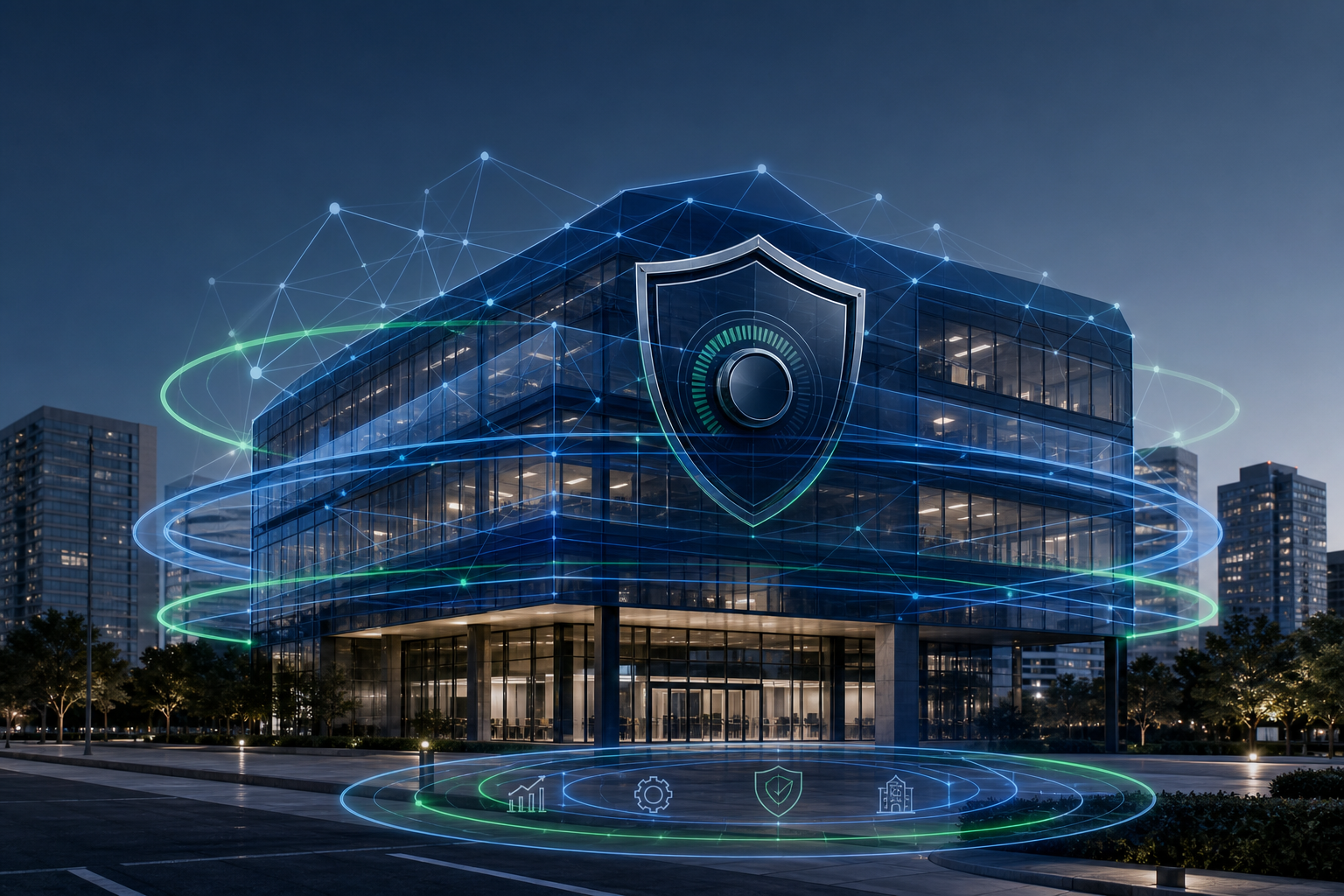
AI is moving past the demo phase in commercial real estate. That is good news for owners only if they control what the AI is learning from.

I have seen this movie before. A new technology arrives with a polished interface, a clean promise, and a vendor saying the hard part is already solved. Then the owner signs the contract, the data starts flowing, and the real asset being created sits somewhere the owner does not control.
That is the mistake CRE cannot afford to repeat with AI.
The strategic question is not which model looks most advanced this quarter. The strategic question is whether you own the data, rules, context, and workflows that make AI useful inside your portfolio.
If you don't own your data & digital infrastructure, your vendors do.
That line matters more now because AI is no longer limited to pilots and conference demos. It is moving into capital markets, lease administration, accounts payable coding, construction review, multifamily leasing, and day-to-day operating decisions. Those workflows are where institutional knowledge lives. If AI captures that knowledge inside vendor-controlled systems, owners may gain short-term automation while losing long-term control.
That is not progress. That is a new form of vendor dependency.
The AI Conversation Has Moved From Wonder To Workflow
The early AI conversation in CRE was mostly theatrical. People wanted to see what the model could summarize, draft, answer, or generate. That phase had value. It helped owners see what was possible.
But demos do not run portfolios.
The current shift is more important. AI is being attached to specific owner workflows. Thesis Driven recently described the buildout of an AI capital markets agent, pointing toward tools that help with investor targeting, fundraising preparation, and capital markets execution. That matters because capital formation is not a generic task. It depends on deal history, investor preferences, market timing, asset narratives, risk posture, and the judgment of the sponsor.
The same pattern is showing up in back-office operations. Propmodo’s coverage of AP automation made a sharp point: the hard part is not invoice extraction, but judgment. A $4,200 landscaping invoice may look simple until the system has to determine property allocation, chart-of-accounts coding, service period, contract terms, recoverability, budget variance, and whether the charge belongs in OpEx, CapEx, or a tenant recoverable bucket.
That is not just data entry. That is owner logic.
Multifamily leasing is moving in the same direction. Multifamily Dive’s sponsored case study on agentic AI in multifamily operations focuses on AI capturing leads and freeing teams from repetitive work. Whether the application is leasing, AP, construction review, or capital raising, the pattern is the same: AI is leaving the sandbox and entering workflows that shape revenue, expense control, tenant experience, and operating risk.
That is where asset managers need to pay attention.
A model can draft an email. A workflow decides whether NOI improves, risk drops, or the portfolio becomes harder to unwind from a vendor later.
The Model Is Not The Moat
Most owners are still asking the wrong AI question.
They ask, “Which AI tool should we buy?”
The better question is, “Which parts of our operating intelligence must remain under owner control?”
Models will keep changing. Costs will keep moving. Vendors will keep releasing new capabilities. The AI market is not going to stand still long enough for any owner to build a durable strategy around one model name.
That is why the moat is not the model. The moat is the layer above it: your proprietary data, your rules of use, your workflows, your approval rights, your exception handling, your institutional memory, and your ability to change vendors without rebuilding the property.
This is the practical side of AI readiness. Laurent Cochet’s interview on AI-driven transformation emphasizes that many leaders are not blocked by access to technology; they are blocked by execution and adoption. The discussion in How to Embrace AI-Driven Transformation points to a lesson CRE owners should take seriously: technology availability is not the same thing as operating capability.
That distinction is everything.
An owner can subscribe to an AI tool tomorrow. That does not mean the portfolio has governed data. It does not mean permissions are clear. It does not mean source systems are trustworthy. It does not mean the same operating definition applies across ten properties. It does not mean a decision can be traced, challenged, or improved.
Without those things, AI becomes a faster way to spread ambiguity.
I am not anti-vendor. Vendors matter. Specialist tools matter. Vertical applications matter. But the owner must decide where the permanent intelligence lives. If every AI workflow becomes trapped inside a separate vendor environment, the portfolio becomes a patchwork of partial intelligence.
That patchwork will show up later in the places asset managers care about most: refinancing, diligence, insurance review, expense trajectory, and exit valuation.
Workflow AI Can Create Value Or Trap It
The financial case for AI in CRE will not be won with novelty. It will be won inside repeatable workflows that affect NOI, DSCR, risk, and retention.
Take AP coding. If AI helps classify invoices faster, that is useful. But if the coding logic lives only inside a vendor’s black box, the owner may not understand why decisions were made or how those decisions compare across assets. That creates reporting risk and diligence risk.
Take lease administration. AI can extract clauses, dates, rights, options, and obligations. But if lease intelligence sits inside a vendor platform and cannot connect cleanly to property operations, budgeting, tenant communications, and capital planning, the owner still lacks portfolio control.
Take construction review. AI can help flag issues across documents, budgets, schedules, and change orders. But if the owner does not govern the underlying documents, approvals, exceptions, and project history, the system may accelerate review without improving accountability.
Take capital raising. AI can help organize investor outreach and prepare materials. But the durable asset is not the email draft. The durable asset is the owner’s capital markets memory: who engaged, why they passed, what risk they flagged, which story worked, and how that learning should inform the next raise.
The same logic applies to multifamily leasing. Capturing leads quickly matters. But the owner should care about the full revenue path: source quality, response rules, pricing discipline, availability data, concessions, conversion, retention exposure, and portfolio-level pattern recognition.
AI is only as valuable as the owner-controlled context around it.
Without that context, owners risk confusing automation with intelligence.
Automation performs a task. Intelligence improves a decision. Owner-controlled intelligence compounds across properties, teams, vendors, and hold periods.
Vendor-Controlled AI Is A Silent Transfer Of Institutional Knowledge
Every owner has institutional knowledge that never appears neatly on the P&L.
It lives in the asset manager’s judgment. It lives in the property team’s history with tenants. It lives in how exceptions are handled, which vendors get trusted, how insurance risk is evaluated, how capital plans are sequenced, and which operating signals matter before a number hits the monthly report.
AI is very good at absorbing patterns. That is why it is powerful. It is also why owners need to be careful.
When a vendor-controlled system becomes the place where your exceptions, corrections, approvals, operating preferences, tenant patterns, and capital decisions are captured, that vendor is not just providing software. It is becoming the keeper of your operating memory.
That may feel harmless at the property level. Across a portfolio, it becomes structural risk.
Can you extract the data in usable form?
Can you see the logic behind the recommendations?
Can you apply the same rule set across different vendors?
Can you change tools without losing years of workflow learning?
Can you prove to lenders, buyers, insurers, and partners how decisions were made?
If the answer is no, the owner does not have intelligence. The owner has access.
Access is not control.
This is where asset managers need to widen the frame. AI vendor selection is a procurement decision. AI governance is an investment decision.
One affects software cost. The other affects operating capability, risk, and long-term asset value.
The Owner-Controlled Path Is The PPP 5C™ Plan
At OpticWise, we use Peak Property Performance® to frame this problem through the PPP 5C™ plan: Clarify, Connect, Collect, Coordinate, and Control.
This is not a technology-first process. It is an owner-control process.
Clarify starts with a review of the current state. What systems exist? Who owns the data? Which workflows matter most? Which sources are trustworthy? Where does vendor dependency already exist? Where does the owner lack portability?
Connect builds the owner-controlled network layer through managed data & digital infrastructure. This is where SIC® supports Security, data & digital infrastructure, and Connectivity as a certified platform approach. It is also where BoT® and Building of Things® standards, ElasticISP®, and the 5S® user experience, including Seamless Mobility, Security, Stability, Speed, and Service, create a repeatable operating foundation.
Collect turns fragmented property activity into usable owner data. The goal is not to hoard data. The goal is to capture the right data in a governed form so it can support decisions across the asset and portfolio.
Coordinate governs identity, permissions, privacy, lineage, retention, vendor access, and rules of use. This is where AI moves from risky automation toward controlled operating intelligence.
Control is where Property Brain™ and Portfolio Brain™ matter. Property Brain™ gives an asset an owner-controlled intelligence layer. Portfolio Brain™ extends that capability across the portfolio so owners can compare, improve, and scale decision logic without rebuilding every property from scratch.
This is the two-layer model.
Layer 1 is managed data & digital infrastructure: the owned network, connectivity, systems, and data foundation.
Layer 2 is the owner-controlled intelligence layer: the governed data plane and trust plane that allow AI tools, decision engines, and workflows to operate under owner rules.
The point is simple. Owners should be able to use the best AI tools available without surrendering the intelligence that those tools create.
What Asset Managers Should Do Now
Do not start with a model comparison.
Start with the workflows where AI will touch money, risk, or institutional knowledge.
For most owners, I would begin with five questions.
First, where is AI already entering the portfolio through vendors, even if it was not approved as an AI strategy?
Second, which workflows affect NOI, DSCR, retention exposure, capital planning, or diligence findings?
Third, who owns the data created by those workflows?
Fourth, can the owner extract that data, logic, and history in a usable format if the vendor relationship changes?
Fifth, what governance exists around permissions, source truth, exception handling, and decision traceability?
Those questions will tell you whether AI is building owner capability or vendor dependency.
The owners who win this next phase will not be the ones with the most AI pilots. They will be the ones who convert AI activity into repeatable operating intelligence they own.
That is the difference between a demo and a durable advantage.
AI in CRE is real. It is already entering the workflows that shape performance. But the owner’s mandate has not changed: protect NOI, reduce risk, preserve control, and build assets that hold value through refinancing, diligence, and exit.
The model will change. Your data & digital infrastructure should not be something you have to renegotiate every time it does.
Own your data & digital infrastructure. Operate with strategic foresight. Build for the long game.
References Cited
Thesis Driven ("Building Your AI Capital Markets Agent") https://www.thesisdriven.com/letters/r/f1940a5a?m=e235afe8-2b90-443c-b913-4a762616110f
Propmodo ("The Real Problem With AP Automation in CRE Isn't Extraction, It's Judgment") https://propmodo.com/the-real-problem-with-ap-automation-in-cre-isnt-extraction-its-judgment/
Multifamily Dive ("How Agentic AI Is Reshaping Multifamily Operations") https://link.diveto.net/oc/684050146d32d21219064634rgfpi.90j/28dd12ee
Laurent Cochet Substack ("How to Embrace AI-Driven Transformation: Insights from Keith Carter") https://laurentcochet.substack.com/p/how-to-embrace-ai-driven-transformation