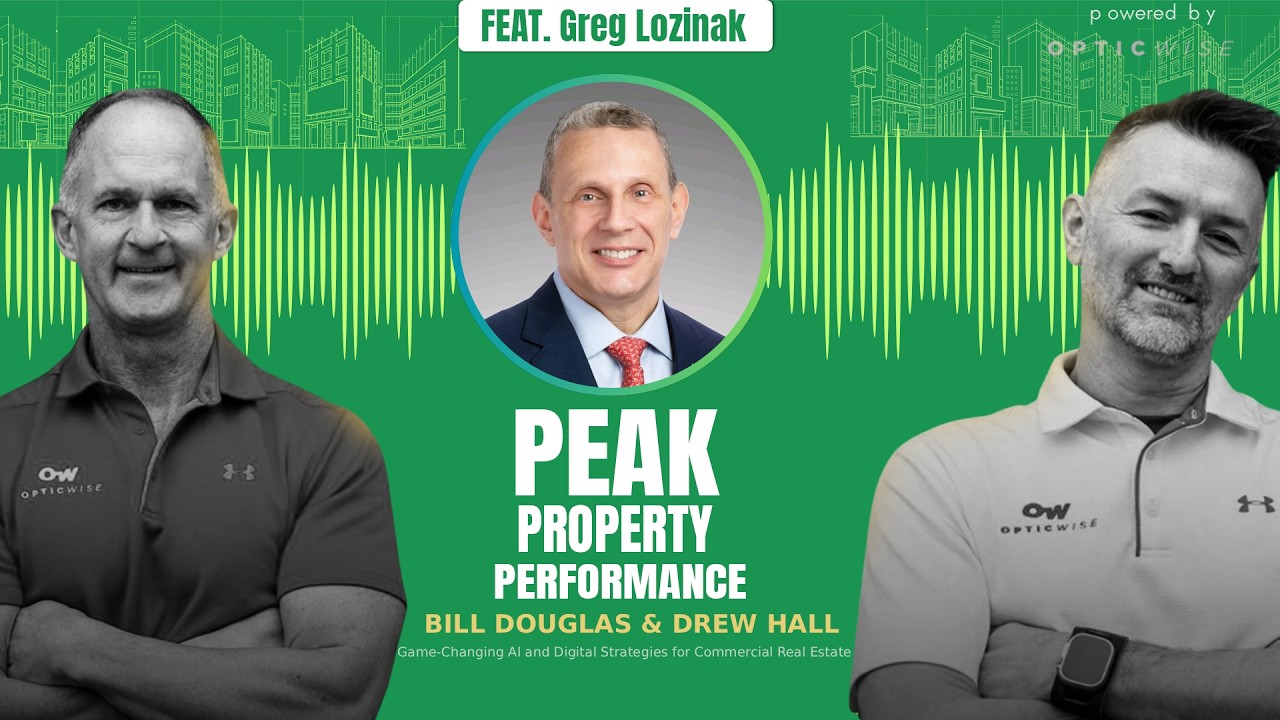
In commercial real estate, the distance between underwriting assumptions and day-one operations is where value-add deals succeed or struggle. In this episode of the Peak Property Performance® Podcast, Gregory Lozinak, a multifamily capital development and repositioning veteran, walks through the specific points where underwriting models diverge from operating reality, and what owners and operators can do about it before those gaps show up in the P&L. If you don’t own your data & digital infrastructure, your vendors do, and this conversation demonstrates why operational visibility, grounded in clean data, is what connects assumptions to results. Listen to the full episode for the complete discussion.
Where Rent and CapEx Models Break Down
Greg Lozinak identifies a structural shift that makes underwriting harder than it was a decade ago. When the market rewarded financial engineering and cap-rate compression, operators could absorb modeling errors because asset values rose around them. Today, "Real estate has moved from a financial asset to an operational asset." That means the margin for error in operating assumptions has compressed. Two areas surface most often.
The first is rent growth timing. Many models assume linear rent growth from acquisition close. In multifamily, lease expirations are staggered. If 30% of units roll in the first quarter and the remaining 70% are locked at legacy rents for another nine months, the model's Year 1 revenue cannot be achieved no matter how strong the market. Front-loading growth expectations into a staggered rollover schedule creates a structural shortfall visible within 90 days.
The second is CapEx sequencing. Value-add sponsors often plan interior renovations first because those drive unit-level premiums. Greg argues for the reverse: front-load exterior and common-area improvements to shift curb appeal and attract the demographic willing to pay the renovated-unit premium. "You can’t expect to start renovations on day one of month one," he notes. Starting interiors before the property signals a repositioned identity means renovating into the same tenant pool, which delays the rent capture the model assumed.
KPIs vs. KPRs: Leading Indicators vs. Lagging Confirmation
Greg introduces a distinction most operators overlook in their reporting stack. Key Performance Indicators should be forward-looking metrics that drive outcomes: lease conversion rate, tour-to-application ratio, renewal acceptance rate, notice-to-vacate pace. Key Performance Results (KPRs), by contrast, confirm what already happened: occupancy percentage, collected revenue, turnover cost. Most dashboards report KPRs and label them KPIs.
Drew: “How do you separate what’s actually happening at a property versus what’s being reported up the chain?”
The practical risk is that operators manage to the lagging number. Occupancy looks stable at 94%, but the conversion funnel feeding that number is deteriorating. By the time occupancy drops to 91%, the pipeline shortage started six weeks earlier and recovery requires another full lease-up cycle. The same principle applies to revenue: "You may be better off at a lower occupancy, but with higher rent collection," Greg explains. A property at 92% occupancy collecting 99% of billed rent often outperforms one at 96% collecting 93%. The data to distinguish those states has to exist, be trustworthy, and be visible to the asset manager in time to act.
Execution Risk Shows Up in the First 30 Days
Greg makes the timeline concrete. In a value-add acquisition or repositioning, execution risk does not wait for Year 2. It surfaces within the first 30 days if assumptions were aggressive. The operations team has a clearer read on achievability than the financial model does, which is why Greg insists they be involved during diligence, not handed the model after close.
Bill: “How early does execution risk typically show up?”
"You have to understand what assumptions you’re trying to achieve and make sure you have that conversation with the operations team about what needs to happen to do that." When operators only see the model after closing, they inherit targets they had no voice in setting. The feedback loop is broken from day one.
Greg advocates for a culture that surfaces problems early: "Bad news does not get better with age." In practice, that means the asset manager needs a data source that shows early variance between plan and actuals, not a monthly report that arrives too late to course-correct. Whether the variance appears in leasing pace, renovation completions, or collections, the speed of visibility determines the cost of correction.
When Technology Creates Complexity Instead of Clarity
Bill Douglas raises a parallel risk. Many operators have adopted multiple point solutions, each strong in its category, that do not share a common data layer. The onsite team ends up logging into six or seven systems, each reporting partial truths, with no single view of what is actually happening across the property.
Drew: “An operating system at the site level needs to pull in all the data from different softwares into one dashboard.”
Drew Hall makes the architectural point. Early in his career he believed in assembling "best-in-class" tools for each function. The integration tax, both technical and human, often exceeded the incremental feature value. "You might be better off with fewer pieces to integrate," he suggests. The goal is not more tools; it is a consolidated operating view that site teams can act on without becoming software technicians. When that consolidation works, properties can move toward more autonomous operations where the staff spends time on resident experience and revenue rather than reconciling conflicting reports.
Data and Digital Infrastructure as a Diligence Standard
Greg connects the thread directly to asset valuation. If data and digital infrastructure are the foundation for operating performance, and operating performance is what drives value in a post-compression market, then the quality of that foundation should be part of acquisition diligence.
Greg Lozinak: “Digital infrastructure and data should be part of diligence, should drive value.”
In practice, that means asking during due diligence: what data does the current owner actually export and retain? How much operating history transfers at close? Which vendor systems hold data the buyer will need but may not be able to extract cleanly? How long will it take to stand up a trustworthy operating view after acquisition? The answers to those questions affect time-to-stabilization, which feeds directly into return projections. For a deeper exploration of how data and digital infrastructure connects to property performance, the Peak Property Performance® book covers the full framework.
Actionable Takeaways for CRE Owners
From the conversation with Greg Lozinak, several principles emerge for owners looking to close the gap between underwriting assumptions and operating results:
- Involve operations during diligence, not after close. Let the team that will execute the plan pressure-test the model before capital commits. If assumptions require conditions the operations team cannot confirm, adjust before signing.
- Separate leading indicators from lagging results. Structure reporting so asset managers see conversion rates, renewal pace, and collection ratios (KPIs) alongside occupancy and revenue (KPRs). Act on the leading signals.
- Sequence CapEx to match the revenue model. Exterior and common-area work repositions the property's identity. Interior renovations capture the premium. Reversing that sequence delays the rent growth the model assumed.
- Consolidate the operating view. Fewer integrated systems with a shared data layer outperform a collection of best-in-class tools that cannot produce a single source of truth at the property level.
- Treat data and digital infrastructure as a diligence item. Operating history that does not transfer at close has to be rebuilt, and the time cost of that rebuild affects return timing.
For more expert discussions on bridging underwriting and operations, visit the Peak Property Performance® Podcast hub.
About OpticWise: OpticWise provides owner-controlled data & digital infrastructure for commercial real estate, from PPP Audits to portfolio-wide intelligence. See how we operate or read customer outcomes.
Peak Property Performance® Podcast
Have a story to share?
We’re always looking for CRE leaders with real-world experience in data, digital infrastructure, and building operations.
Request to Be on the Show