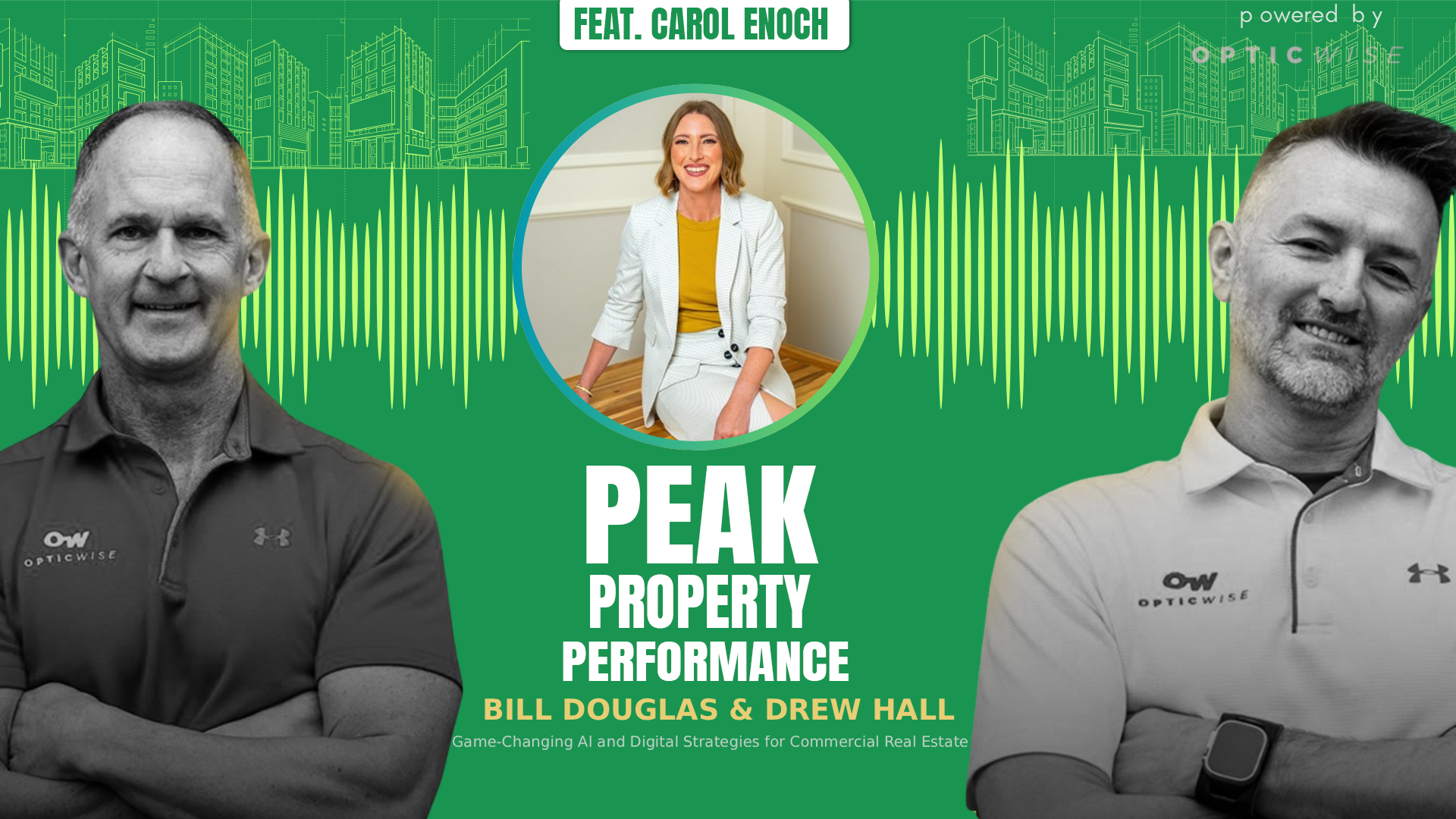
Multifamily performance suffers when ownership's financial expectations, the asset manager's strategy, and the property team's daily priorities drift apart. Rent growth and expense savings depend on people who understand the plan, have reliable information, and can act on what they see. In this Peak Property Performance® conversation, Bill Douglas speaks with multifamily asset manager Carol Enoch about the practical work behind consistent investor returns. Her experience across leasing, operations, consulting, and asset management gives her a clear view of where those connections break. You can listen to the full episode for the conversation.
I think probably my biggest pet peeve right now is that I pay for my own data to get my own data back. And then I can't even get it in a format that I want or that makes sense. Drives me nuts.
Carol Enoch
Test the Investment Plan Against Operating Reality
Carol describes acquisition pro formas that tell an attractive story: rents rise, expenses fall, and property improvements produce the intended return. The operators receiving those plans sometimes question where the projected rents came from or how they are supposed to achieve them. The asset manager sits between those perspectives, responsible for understanding the investment strategy while communicating with the people expected to deliver it. That requires carrying market and operating realities back to ownership, then translating the financial objective into something the property team can execute.
Carol sees this disconnect as systemic. Lending requirements help shape the financial story presented at acquisition, while the operating team inherits responsibility for making that story work. She also points out that capable people already raise concerns throughout the industry. What matters is whether decision-makers listen and respond. For an asset manager, the practical implication is to examine operating objections while the plan can still be adjusted. A team questioning achievable rents is supplying information relevant to the investment. Understanding its reasoning gives ownership a better basis for judging the assumptions behind projected income.
Resident Retention Depends on What the Site Team Knows
The property team holds knowledge that can be difficult to capture in a financial summary: what residents want, what keeps them satisfied, and what it takes to persuade them to stay. Carol says asset managers without operating backgrounds can undervalue that work when attention concentrates on NOI targets. Her point connects resident experience directly to the source of property income. Residents pay rent, those payments support net operating income, and that income informs the property's value. Keeping residents requires giving the people serving them the tools and understanding to do their jobs well.
We shared an example from a property visit where the manager knew residents by name and the atmosphere felt welcoming. Residents stopped near the mail area to interact with a cat the team had brought in from the street. The property faced competition from a new building next door, yet its team was especially effective at closing prospects who toured in person. The property managers were trained to handle leasing themselves. Carol's emphasis on education and career development belongs in this discussion: the people creating that experience carry knowledge about the property and its customers that ownership depends on for continued performance.
Technology Needs an Operating Owner and Usable Data
Technology introduces another source of performance risk when responsibility ends at purchase. In the conversation, we describe organizations buying overlapping tools, leaving systems unimplemented, or developing code that disappears from use when its creator leaves or changes roles. Carol argues that teams have a responsibility to understand the tools they use and apply them to asset performance. The operating requirement is straightforward: someone must oversee implementation, document how the tool works, and preserve the knowledge needed to keep using it. Otherwise, the organization continues paying for capabilities that never become dependable parts of its work.
Carol's data example shows how this affects investment decisions. Her operators use separate systems for property management, applications, and customer relationships. When those systems fail to share trustworthy information, staff maintain manual spreadsheets. Carol then has to make business decisions using records she cannot confidently rely on. We connect that problem to owner-controlled data & digital infrastructure: owners need usable access to the information their properties generate, with clear rights to retain and move it. The immediate task is to establish which records the asset manager can trust and how those records reach the person accountable for performance.
Make Compensation Reflect the Return Ownership Keeps
Carol describes taking over a troubled asset for a client and structuring her asset management fee as a percentage of net operating income. That arrangement tied her compensation to the financial result she was responsible for improving. She contrasts it with fees calculated from gross collected rent, where expenses do not enter the calculation. The distinction matters when the assignment includes expense management: revenue can increase while higher costs absorb the benefit. A fee based on NOI gives both parties a shared interest in what remains after operating expenses. Carol says the arrangement strengthened an already established relationship with the client because their financial interests were aligned in the agreement.
The relationship also extended through disposition. Carol's team helped on the operating side of the sale and received a percentage of the value it helped create. We discussed shared incentives as a practical way to connect a provider's compensation to the outcomes ownership values. For an asset manager reviewing an engagement, this raises a specific question: does the fee reward the full scope of the assignment? If the provider is expected to manage income and expenses, the compensation formula deserves scrutiny alongside the service description. Carol's example gives owners a concrete arrangement to consider when engaging an asset manager, with the ongoing operating return and the value created at sale both reflected in how the work was rewarded.
Write Agreements That Survive the People Who Negotiated Them
Carol's managed Wi-Fi negotiation illustrates a separate investment risk: an agreement that leaves essential commitments outside its binding terms. The provider would not specify in the agreement what data & digital infrastructure the owner would own, repeatedly referring to notes or prior conversations. Carol insisted that the ownership terms belong in the agreement itself. Her approach to contract review draws on her earlier experience working for an attorney: someone unfamiliar with the negotiation should be able to read the document and understand what the parties agreed to. For an owner, that standard makes the contract usable when staff change, a renewal approaches, or another person has to evaluate the relationship. Written ownership boundaries give that person a basis for action without reconstructing conversations.
I'm not going to sign something that I can't promise.
Carol Enoch
The same negotiation included a requirement to fix any issue affecting the provider's operations within the same business day. Carol could not commit to that obligation and walked away when the parties could not resolve those terms. Her decision shows why contract review needs to examine what ownership is being asked to promise, as well as what the provider is offering. A response obligation should be assessed against the owner's actual ability to deliver it; describing a clause as standard does not make it workable. We also raised the practical question owners can bring to vendor discussions: what remains theirs if they replace the provider? Together, these checks help make future decisions answerable from the agreement. The Peak Property Performance® book develops the owner-control approach behind those questions. The Peak Property Performance® Podcast brings additional perspectives from the people negotiating, managing, and investing in these assets.
Start with a PPP Review on one asset. Map ownership, leakage, and the path to control. Capitalize the upside before exit.
About OpticWise: OpticWise provides owner-controlled data & digital infrastructure for commercial real estate, from PPP Review to portfolio-wide intelligence. See how we operate or read customer outcomes.
Own your data & digital infrastructure. Operate with strategic foresight. Build for the long game.