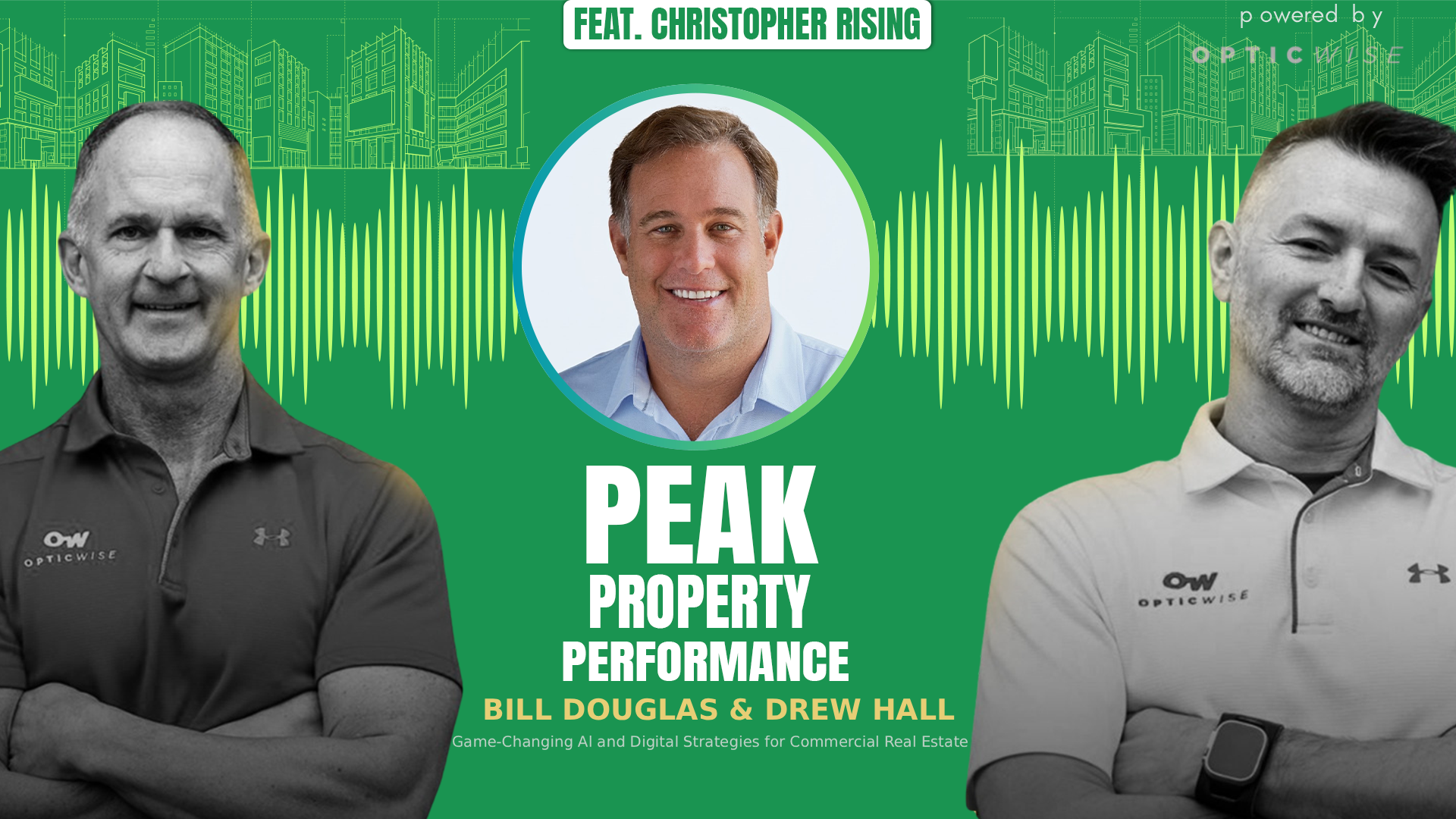
You can invest in an office suite, find a tenant ready to sign, and still have the lease threatened by internet service you assumed the tenant would arrange. The same ownership problem extends into building systems: vendors can control access to the operating data you need to evaluate performance. In our Peak Property Performance® conversation with Christopher Rising, co-founder and CEO of Rising Realty Partners, we explored how those decisions affect leasing, operating costs, and your ability to control the asset over time.
A finished suite still needs to support the tenant’s business
Rising described a spec office suite in downtown Los Angeles that attracted a prospective tenant sooner than expected. His team had committed capital to the space, and the tenant was ready to move forward. Then came the question about internet service. The tenant’s willingness to sign depended on getting connected, and the owner could not secure service within the requested timeframe. The tenant ultimately signed because competing properties could not meet that timeframe either. But the experience exposed a leasing dependency that Rising’s team had treated as somebody else’s responsibility.
That experience led Rising and his team to establish their own internet service business, which he said later expanded into approximately 160 buildings across multiple states. The investment lesson begins with the tenant’s ability to use the space. Connectivity belongs in the leasing conversation early enough to establish what is available, how service will be delivered, and whether the timing supports occupancy. As we discussed on the podcast, a building-wide strategy also gives ownership a way to evaluate capacity and redundancy before separate tenant decisions create additional cost and complexity.
Acquisition diligence needs to reach the contracts behind the systems
As Rising learned how to bring service into the building, he discovered an inherited agreement giving a riser company control of the building’s risers for roughly a decade. Nobody had raised that agreement during acquisition diligence. The risers carry cabling through the building, so control over them affected how his team could deliver connectivity. Rising’s response was to develop working relationships with riser companies. His account shows why a contract governing access to part of a property deserves attention alongside the physical condition of that property.
For an asset manager, this means asking who controls the routes, systems, and data needed to carry out the business plan. An acquisition can come with obligations that constrain a future service offering or require cooperation from an incumbent provider. Reviewing those agreements before closing gives you time to understand the restrictions and account for them in your plans. We encourage owners to begin by mapping what they own, who holds the credentials, and which contracts govern access. That is the Clarify step of the PPP 5C™ plan, applied to a decision with direct consequences for leasing and capital deployment.
Data rights require a deliberate commercial decision
Rising said his team now puts data rights into vendor negotiations and reads agreements more carefully than it once did. He also acknowledged the limits of an owner’s bargaining power. A needed system may come with terms the vendor will not change, leaving ownership to decide whether the service justifies those concessions. That makes the review worthwhile even when it does not produce every right you request. You can make an informed decision about access, use, and control before committing to the relationship.
You know, we don't always, sometimes we need that, what that vendor is selling and we can't own the data the way we want to, but at least we're aware of what we're giving away compared to the old days.
Christopher Rising
We see owner-controlled data & digital infrastructure as a practical requirement for making those decisions over the life of a property. Your agreements should address whether you can export operating records, retain history after a vendor change, and authorize another tool to use the data. Those rights matter when evaluating HVAC performance, security systems, or future operating improvements. Start with an agreement approaching renewal and ask what you would retain if you changed providers. For Rising’s account of how his ownership approach developed, listen to the full episode.
Unused power could change the investment case for an office building
Rising raised a possibility for underutilized office buildings: use available power to support server racks alongside the remaining office tenants. His thinking came from earlier work on office leases, when law libraries required attention to floor loading and word-processing operations required attention to power. Those same physical characteristics could matter to a different user today. Rising described owners potentially submetering power for a smaller data center operation within an existing property. He said his team was having discussions about the idea. For an asset manager considering what to do with vacant space, this introduces another option to evaluate against continued office leasing, a sale, or another conversion. The starting information is specific: how much power the building is allocated, how much it uses, and what the structure can support.
Rising also explained why available space alone would not make a building suitable. Server equipment creates floor-load requirements, and reliable operations require backup power. He described an office property he had owned where a data center occupied a floor while office tenants occupied the rest. The data center consumed the available power allocation, preventing further expansion of that use. That experience gives the proposal an important constraint: an owner would need to understand how competing uses draw on the same capacity. Rising also tied the opportunity to acquisition basis and the capital required to prepare a property. A buyer acquiring at a lower basis could have a different investment decision from an existing owner with a higher basis. Before underwriting server revenue, establish the usable power, structural requirements, backup needs, and cost of making the space suitable.
Shorter leases would change how owners evaluate capital spending
Looking ahead, Rising predicted that more office tenants would seek flexible commitments and expect a more fully serviced experience. He described a future in which only the largest companies would occupy entire buildings or large portions of them, while other businesses would seek shorter leases. In that setting, owners could face more frequent decisions about whether their properties still meet tenant needs. Rising expected power, amenities, and investment in data & digital infrastructure to become increasingly important to attracting those businesses. He also described his own technology priorities in practical terms:
It matters in the sense of cost and it matters in the sense of reliability.
Christopher Rising
That is a useful basis for evaluating capital that may serve successive tenants. If an improvement will remain useful through several leasing cycles, you can assess its cost over those cycles and consider what would need to change with each incoming business. Rising also connected the future office model to owners’ efforts to lower operating costs, which would require understanding the information their buildings produce. We would begin with a specific operating decision, such as whether building schedules match actual use, then identify the records needed to make it. That gives the investment a job you can evaluate and gives the operating team a clear reason to use the information. The Peak Property Performance® book develops the steps for turning that work into an ongoing practice. For more conversations about how owners evaluate changing uses, operating requirements, and capital decisions, visit the Peak Property Performance® Podcast.
Start with a PPP Review on one asset. Map ownership, leakage, and the path to control. Capitalize the upside before exit.
About OpticWise: OpticWise provides owner-controlled data & digital infrastructure for commercial real estate, from PPP Review to portfolio-wide intelligence. See how we operate or read customer outcomes.
Own your data & digital infrastructure. Operate with strategic foresight. Build for the long game.