AI Readiness · Vendor Independence · Portfolio Strategy
Wall Street Just Built an AI Orchestration Firm. Owners Need Their Own.
Read the move, not the press release. The biggest GPs in the world have full access to every frontier model. They could buy a license tomorrow. They didn’t. They built a dedicated firm to handle orchestration. That’s the tell.
TL;DR: The model is the commodity. The moat is the layer above it. Anthropic, Blackstone, Hellman & Friedman, and Goldman Sachs just put serious capital behind that thesis by spinning up a dedicated AI orchestration firm. CRE owners face the same problem at portfolio scale, every vendor pitching an AI-something is offering to be your orchestration layer on their terms. The owners who win the next decade build their own: an owner-controlled data plane, a governed trust plane, and an LLM- and vendor-agnostic Property Brain™ that scales to Portfolio Brain™. Three concrete moves below.
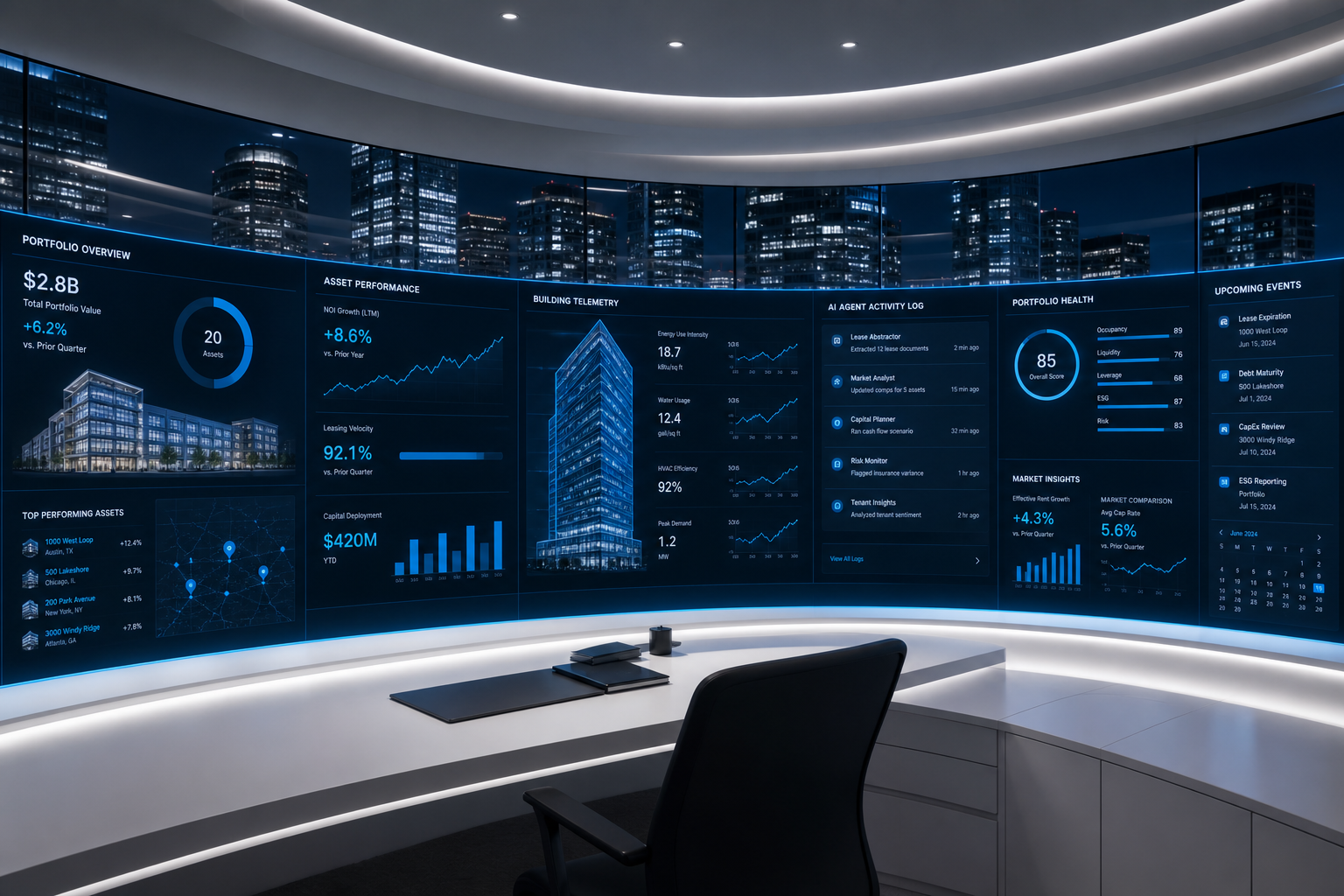
This week, Anthropic, Blackstone, Hellman & Friedman, and Goldman Sachs announced a new standalone AI-native enterprise services firm. Anthropic engineers will be embedded directly. The mission: bring Claude into the core operations of large enterprises faster than those enterprises could on their own. Read the press release closely and one fact carries more weight than any quote in it: the largest GPs in the world just decided that the orchestration layer is worth its own balance sheet. That should land hard for every commercial real estate owner.
What was just priced
Per Stanford’s 2026 AI Index, the performance gap between open-source AI and frontier models shrank from roughly 8% to 1.7% in a single year. Cost to hit benchmark performance is falling 5–10x annually. Most enterprises are running three or more model families simultaneously. The model is becoming a commodity. What was always going to follow that commoditization is what Blackstone, H&F, and Goldman just did publicly: pour serious capital into the layer above the model, the orchestration layer. The thing that decides which model is doing what work, against which data, under whose permissions, with what guardrails, and inside which workflows.
The CRE owner’s version of the same problem
Here is what an owner reads when that announcement crosses the desk. The biggest capital allocators on earth, with full access to the smartest models, decided they cannot just buy the model. They need a dedicated firm to embed it correctly inside their operations. So they built one.
Now compare that to the conversation happening inside most owners’ offices. Every vendor (the OEM platform, the property management software, the new AI-leasing tool, the smart building dashboard) is in effect offering to be your orchestration layer. They will decide which model runs against your data, in their environment, under their identity, with their logging, with their lock-in. That is not orchestration. That is rental. If you don’t own your data & digital infrastructure, your vendors do, and the building’s intelligence becomes someone else’s asset.
Why orchestration matters more than model choice
Orchestration is the governed plane that decides which model, vendor, or decision engine acts under what rules. Four things have to be true for it to work:
- The owner’s data is reachable in a portable, lineage-clean form, not buried inside a vendor SaaS.
- The owner’s identity and permissions decide who and what can act, not the vendor’s.
- The audit trail belongs to the owner.
- The decision engine, the model, and the vendor are swappable without losing data, governance, or institutional knowledge.
If any of those are not true, you do not have orchestration. You have a vendor doing it for you on terms you did not write. CREtech and JLL have both acknowledged that the conversation has moved past whether agents will run lease admin to who is actually accountable for what they do. Agents act under permissions. Whose? That is an orchestration question, not a model question.
What this looks like for a CRE portfolio
Bring it down to one building. A 300-unit asset has at least eight to twelve OT and tenant-experience systems generating data daily. Lighting controls. Access control. HVAC. Submetering. Leak detection. Camera analytics. Parking. Resident engagement. Each one sold by a different vendor with a different cloud, a different identity store, a different data export rule. Now layer in three or four AI assistants the operations team is starting to use. Each one reading from a different slice of the stack, none of them coordinated, all of them claiming permission to act. That is not Property Brain™. That is shadow orchestration. The owner thinks they are running their building. They are running the vendors’ decision engines.
The four moats, restated for owners
After two years of AI noise, the durable advantages for a CRE portfolio come down to four things only the owner can build:
- Proprietary data, the data the buildings already generate, captured and made portable. PPP 5C™: Clarify and Collect.
- Operating workflows, the monthly and weekly plays that turn data into action. Coordinate.
- Orchestration layer, the governed plane that decides which model, vendor, or decision engine acts under what rules. Coordinate and Control.
- Institutional knowledge encoded into systems, the owner’s operating standard, made repeatable across the portfolio.
Property Brain™ → Portfolio Brain™ is built to outlast any single model, any single vendor, any single platform. Vendor- and LLM-agnostic by design.
Standardize once at one property. Scale the standard across the portfolio. The model can change tomorrow; the data plane and the trust plane underneath should not.
What to do this week
The Anthropic + Blackstone announcement is a forcing function. Three concrete moves for owners with portfolios above $500M:
- Run a Property Brain™ readiness check on one asset. Before adding another AI assistant or signing another vendor, confirm the asset has an owner-controlled data plane (Layer 1) and a starting trust plane (Layer 2). Every AI you add without these in place compounds the lock-in.
- Inventory which AI tools are already running in your buildings, including those embedded in vendor platforms you renewed last year without reading the AI clauses. Johnson Controls just acquired Nantum AI to fold its HVAC optimization into OpenBlue. That is one example of a much bigger pattern. Every vendor in your stack is either becoming an AI vendor or being acquired by one.
- Decide who in your organization is accountable for orchestration. Not IT. Not property management. Not asset management. The orchestration layer for operating technology is its own discipline. If no one owns it, vendors do.
Wall Street just told you what they think is worth a balance sheet. They built an orchestration firm because the model is the commodity, and the moat is the layer above it. The owners who treat orchestration the same way (as the durable advantage that compounds across model generations) are the ones whose portfolios will price tightest at the next refi, the next sale, the next investor letter.
Own your data & digital infrastructure. Operate with strategic foresight. Build for the long game.
References Cited
- Blackstone: “Anthropic Partners with Blackstone, Hellman & Friedman and Goldman Sachs to Launch Enterprise AI Services Firm”: https://www.blackstone.com/news/press/anthropic-partners-with-blackstone-hellman-friedman-and-goldman-sachs-to-launch-enterprise-ai-services-firm/
- Stanford HAI: “Artificial Intelligence Index Report 2026”: https://aiindex.stanford.edu/
- CREtech: AI Workforce in Real Estate webinar: https://www.cretech.com/
- Johnson Controls: Nantum AI acquisition: https://www.johnsoncontrols.com/