Data & Infrastructure · Multi-Family · AI-Ready Buildings
Your PMS Vendors Are Not Your Data Strategy. You Are.
A new Thesis Driven survey scored the major multifamily PMS platforms on openness. None broke 6.5 out of 10. The lesson for owners is not about vendors. It is about who actually controls your data.
TL;DR: No multifamily PMS scored above 6.5 out of 10 on openness in a recent Thesis Driven survey, even after Yardi shipped an MCP connector for Claude, AppFolio launched a marketplace, and Entrata stood up a developer sandbox. MLQ’s State of AI in Business 2025 found 95% of AI pilots fail; JLL’s 2025 Global Real Estate Technology Survey found only 5% of CRE programs hit their goals. If you don’t own your data & digital infrastructure, your vendors do. The owners pulling ahead are building owner-controlled data layers, the work of the Peak Property Performance® 5C™ plan and Property Brain™.
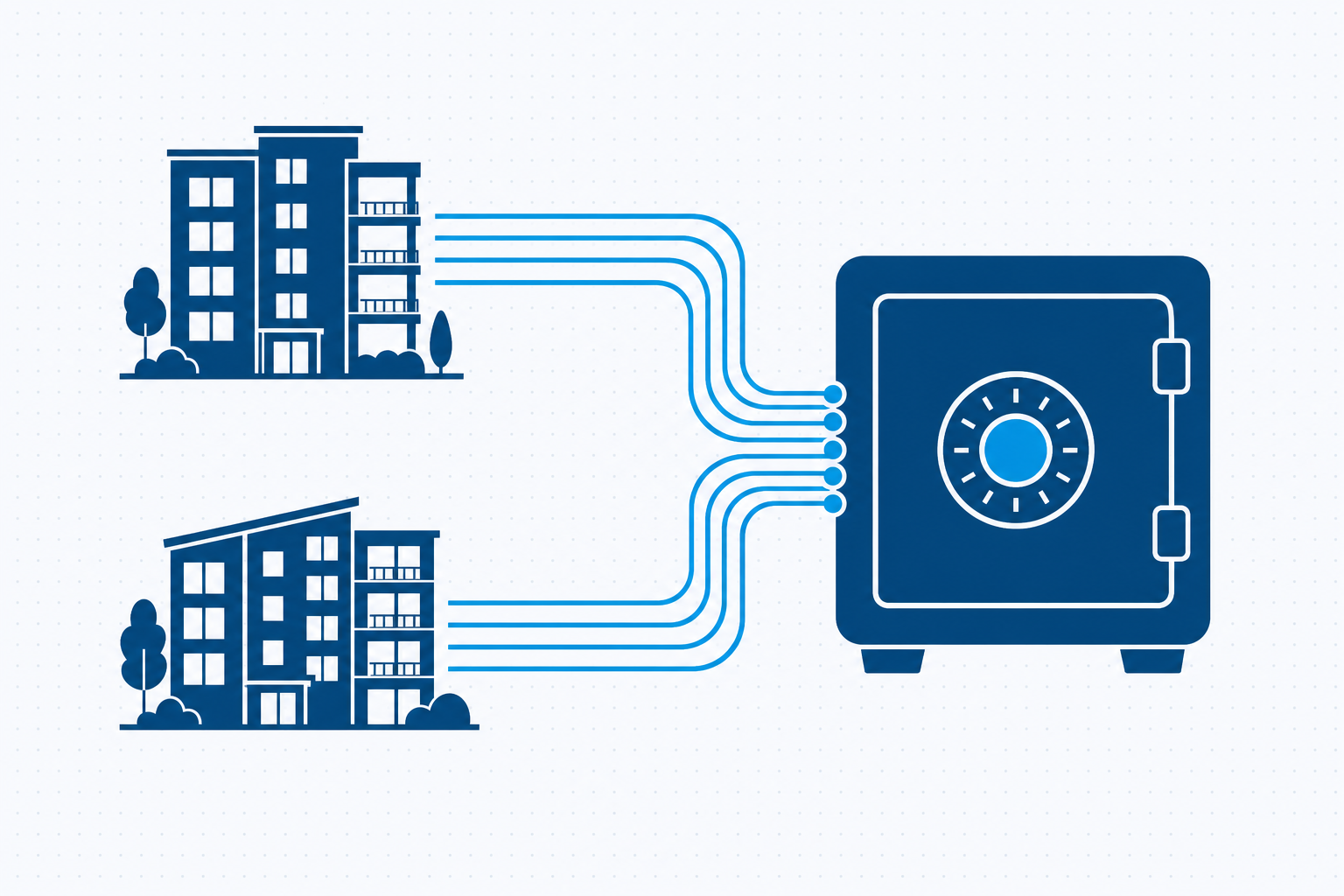
No multifamily PMS scored above 6.5 out of 10 on openness. The lowest came in just over a 3. That is not a vendor problem. That is an architecture problem. A Thesis Driven survey just rated the major multifamily property management systems on openness, and that result held even after Yardi shipped an MCP connector for Claude, AppFolio launched an integrated marketplace, and Entrata stood up a developer sandbox for the first time. Each of those moves was covered in the trade press as progress. The survey says the owner experience hasn’t changed.
Connected is not the same as owned
Multifamily operators today move data in four ways. APIs built for developers, not BI teams. Scheduled reports shaped by whatever the vendor decided to expose. SFTP files that arrive on the vendor’s calendar. And read-only database access, the most powerful option, which most operators don’t get unless they pay six figures for it inside a contract negotiation. None of those four methods give the owner a unified view of what is actually happening in the portfolio.
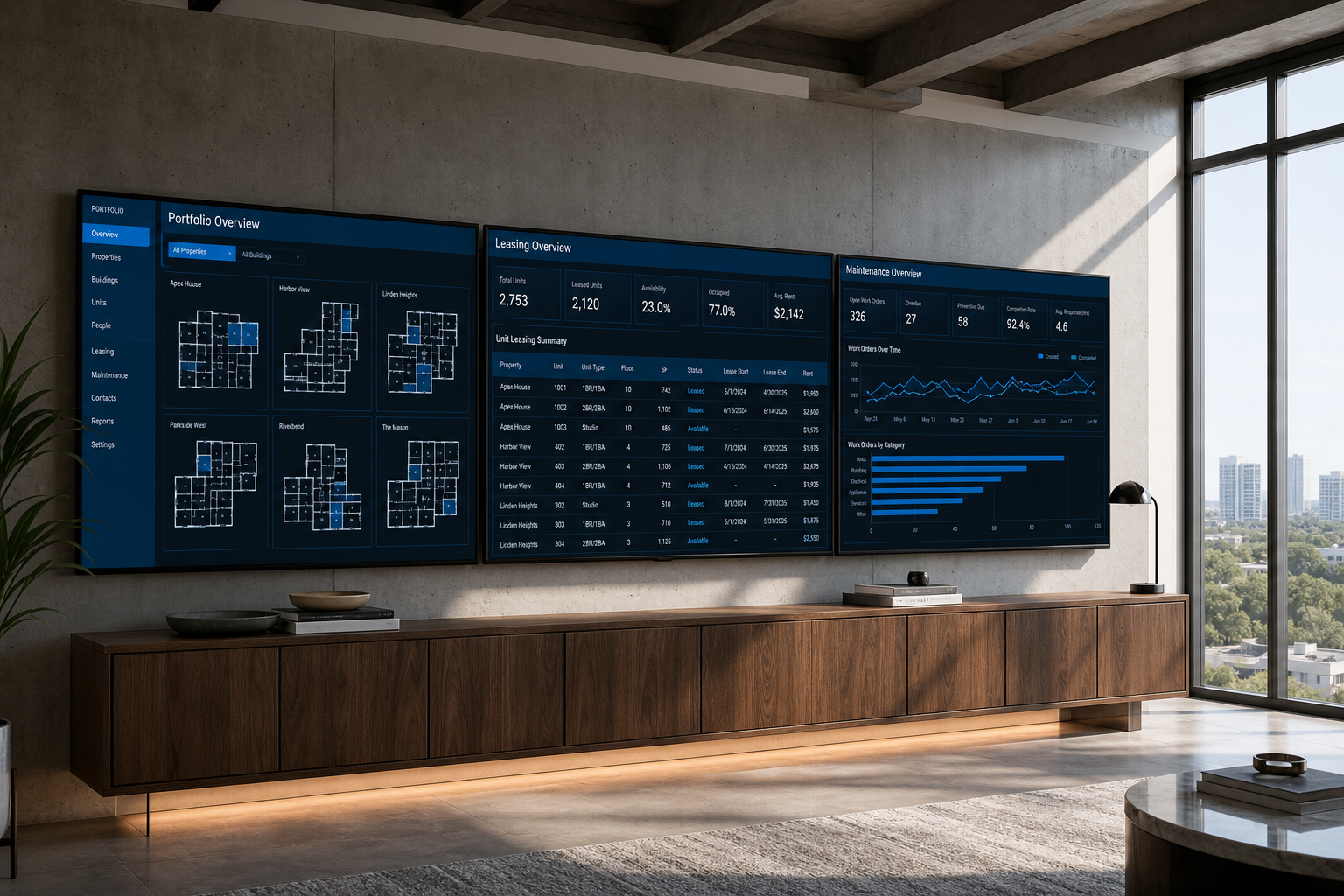
Your PMS knows about leasing. Your maintenance platform knows about work orders. Your CRM knows about leads. Your AI leasing tool knows about prospect chats. None of them know about the resident as a single human being whose history spans all four. None of them share a schema. None of them resolve to a single record you control. The day-to-day cost is decisions you can’t actually make. The strategic cost is bigger: every quarter your fragmented data layer compounds, and every new tool you buy adds another silo to the pile.
AI just made the gap urgent
MLQ’s State of AI in Business 2025 report found that 95% of AI pilots fail. The most-cited reason was the inability to integrate AI with key tools and datasets. JLL’s 2025 Global Real Estate Technology Survey found that 90% of CRE companies are now piloting AI but only 5% have achieved all program goals. Two studies, one finding: AI doesn’t fail because the model is wrong. It fails because the data plane underneath it isn’t ready.
Per Stanford’s 2026 AI Index, the performance gap between open-source AI and frontier models shrank from roughly 8% to 1.7% in a single year. The model is becoming a commodity. The moat is the layer above it. If you don’t have a unified, owner-controlled data layer for your portfolio, you don’t have an AI strategy. You have a dashboard with vendor logos on it.
What the operators pulling ahead are doing
Here is the part of the Thesis Driven piece that should make every multifamily owner stop. Rukus Esi, Chief Digital Officer at AvalonBay Communities, told the publication AvalonBay built its entire technology stack so the data layer remains consistent regardless of which platforms or solutions sit around it. His direct words: “We don’t want to be beholden to any single vendor’s roadmap, and we need to be able to pivot quickly without sacrificing continuity for the business.” That is the Chief Digital Officer of one of the largest apartment owners in the country saying out loud what we have been telling smaller owners for two years.
The pattern outside of real estate is older than that. JPMorgan Chase has more than 450 AI proofs of concept in development and onboarded 200,000 employees onto its internal AI platform in under a year. None of it works without the proprietary data layer underneath. The AI tools get the headlines. The data layer is what makes them work.
The PPP 5C™ plan applied
This is exactly the problem the Peak Property Performance® methodology was built to solve. Clarify, define which data matters, where it lives today, and what is actually trustworthy and portable. Most multifamily owners can’t answer that question for their own portfolio. Connect, establish secure, owner-controlled connectivity across the property and the portfolio. This is where managed data & digital infrastructure replaces the fragmented telecom-and-cable stack at every site. BoT® (Building of Things®) is the OpticWise approach.
Collect, capture and normalize operational data from the PMS, CRM, maintenance, leasing, and on-site building systems into a consistent model in a warehouse you own. The vendor doesn’t own the warehouse. You do. Coordinate, govern identity, access, lineage, and rules of use so the warehouse is auditable and any AI tool can act against it under your permissions, not the vendor’s. Control, plug in the decision engines and workflows that make money. Property Brain™ at the property level. Repeated across the portfolio it becomes Portfolio Brain™, vendor- and LLM-agnostic by design.
What to do now
Three questions. If you can’t answer all three in one minute, your data strategy doesn’t exist yet:
- Can your BI team query across all your operational tools today, in one place, with consistent definitions?
- If you wanted to swap your AI vendor next year, could you, without losing history?
- When the next AVB-EQR-style merger happens in your market, will your data layer be the asset that prices the deal, or the liability that complicates it?
If the honest answers are no, the work is the data & digital infrastructure review. We map what data you actually own, what you don’t, where the leakage is, and what the path to a portable Property Brain™ looks like for one property and then for your portfolio. You can’t apply machine learning to data you turned on yesterday. You need six to nine months of clean operational history before the data is usable. Every quarter you wait is a quarter you stay blind.
If you don’t own your data & digital infrastructure, your vendors do. Stop buying point solutions that trap your data inside a single building. Start building an intelligence layer that scales.
Own your data & digital infrastructure. Operate with strategic foresight. Build for the long game.
References Cited
- Thesis Driven: Multifamily PMS openness survey / Rukus Esi interview: https://www.thesisdriven.com/
- MLQ, State of AI in Business 2025, https://www.mlq.ai/
- JLL: 2025 Global Real Estate Technology Survey: https://www.jll.com/en-us/insights
- Stanford HAI: Artificial Intelligence Index Report 2026: https://aiindex.stanford.edu/